🌐 한국어로 읽기: Korean Version
Quick Overview
USDT0 on Stellar expands the infrastructure for moving dollar-linked assets across blockchains. USDT0 and Stellar’s native asset, XLM, are different assets. This explainer uses official materials checked on October 7, 2026, to explain the transfer model and its remaining risks.
Background
Blockchains keep separate ledgers. Using a token on another chain requires those ledgers to coordinate. USDT0 aims to connect dollar liquidity across networks. For Real World Assets (RWA), it helps to distinguish the asset from the payment infrastructure that carries it. A stablecoin is not the same as a token representing ownership of a Treasury security or property.
Core Concept
USDT is Tether’s dollar-linked stablecoin. A stablecoin targets the value of a reference asset; the label does not guarantee that its market price always holds. USDT0 extends USDT across chains and is built and operated by Everdawn Labs. XLM is Stellar’s native asset. OFT means Omnichain Fungible Token, LayerZero’s cross-chain token standard. A smart contract is a program that executes coded conditions.
How It Works
Original USDT is locked in an Ethereum adapter contract and an equivalent amount of USDT0 is minted on the destination chain. Returning burns USDT0 and unlocks USDT. This is different from redeeming cash into a bank account. Between two OFT chains, tokens are burned at the source and minted at the destination while the Ethereum backing stays put. Supported routes have different conditions; do not assume every chain works identically.
Official Announcement / Real Example
USDT0’s launch post announced Stellar support on September 2, 2026. Stellar’s October 1 developer meeting then explained the implementation and demonstrations. Official USDT0 is on Stellar mainnet; tokens bearing that name on testnet are mocks. Mainnet handles real assets, while testnet is for experiments. A working demo does not establish production support in every wallet or service.
Simple Explanation
Imagine a warehouse receipt accepted at several branches. The original goods stay in storage while another branch issues an equivalent receipt. Moving branches cancels the old receipt and creates a new one. On a blockchain, code, message verification and administrative permissions must work correctly. This analogy explains the accounting; it does not guarantee safety or legal rights.
Meaning and Limitations
Analysis: coordinated transfers could simplify connections between assets managed on separate chains. Convenience does not remove risk. The security documentation describes confirmation by all three Decentralized Verifier Networks (DVNs), audits and an upgradeable design. Audits are not a guarantee against flaws; contracts, message verification and operational changes remain relevant. The Stellar launch announcement also states that the Stellar Development Foundation (SDF) does not issue, custody, redeem or guarantee these tokens.
What Investors Should Watch
Verify both the asset code and issuer in official documentation, rather than trusting the token name. A normal Stellar account needs a trustline: permission to hold that specific asset. Before transferring, check the source and destination networks, recipient address, wallet support, expected amount and fees. Messaging fees for sends from Stellar are paid in XLM; use a current quote. Arrival also depends on the other chain’s finality and message verification, so Stellar’s ledger speed is not the end-to-end delivery time. Wider USDT0 support alone does not establish a higher XLM price.
Key Takeaway
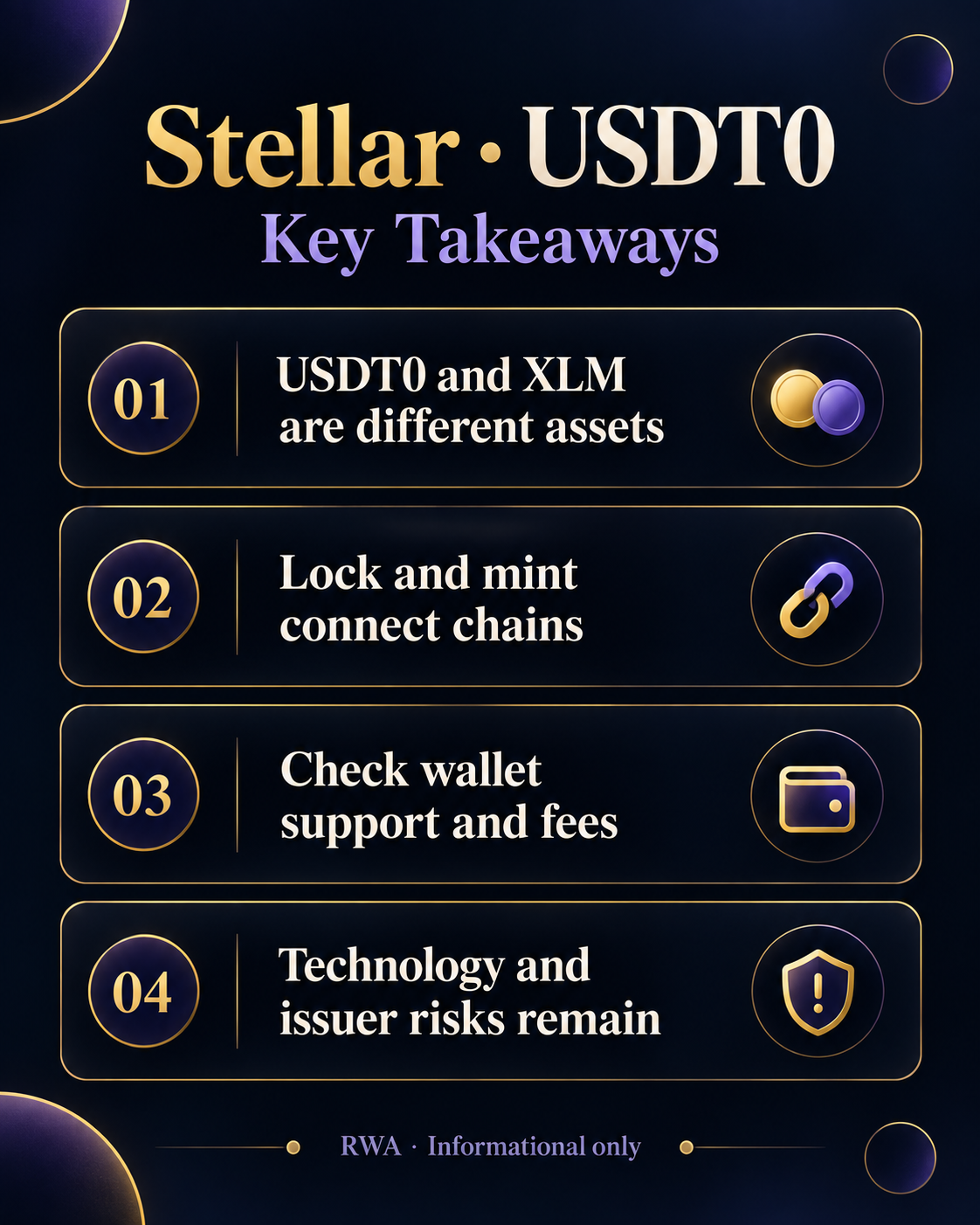
USDT0 connects a dollar-linked asset across separate ledgers. Keep four distinctions clear: USDT0 versus XLM, production versus demos, token transfers versus cash redemption, and technical progress versus investment returns. Understanding the connection also makes its limitations easier to assess.
Official Sources
- Stellar developer meeting — 2026-10-01
- USDT0 Now Live on Stellar — 2026-09-02
- Stellar launch announcement
- USDT0 architecture
- Stellar: USDT0 Transfers with LayerZero
- USDT0 security
- USDT0 transfer guide
- Stellar glossary
This article is for informational purposes only and does not constitute investment advice.