Chainlink Dividend Automation: Tokenized Equity Payouts and Limits
🌐 한국어로 읽기: Korean Version
Quick Overview
Where would a dividend go if your tokenized shares were held in a wallet? In its October 1, 2026 announcement, Chainlink described a Swift hackathon submission automating dividend processing across four blockchains. This article reviews official materials checked on October 7. A hackathon implementation does not establish industry-wide production adoption.
Background
Real-world asset (RWA) tokenization represents asset-related rights through digital tokens. Issuance still leaves operational work: identifying entitled holders, delivering distributions and maintaining records. Readers therefore need to examine both the token and its ongoing administration.
Core Concept
A dividend is a distribution to shareholders, while a token holder’s actual entitlement depends on the product’s legal terms. Chainlink Runtime Environment (CRE) connects tasks across existing systems, blockchains and external data. Automated Compliance Engine (ACE) applies configured identity and eligibility policies. Cross-Chain Interoperability Protocol (CCIP) supports connections for messages and assets between blockchains.
How It Works
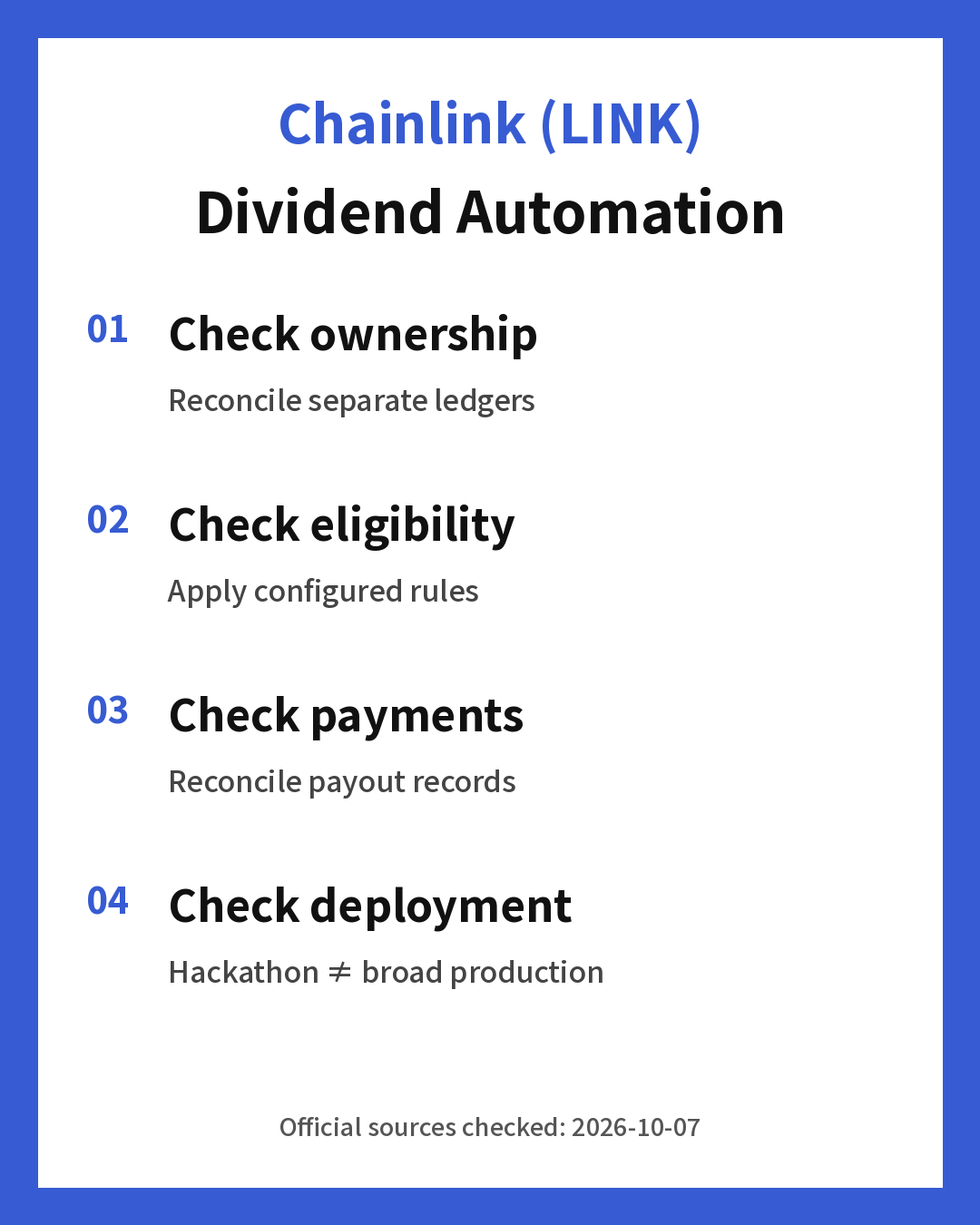
The submitted workflow follows notification, ownership checks, eligibility checks, calculation, payment and reconciliation. Reconciling separate ledgers helps avoid counting a position twice or omitting it. ISO 20022 is a financial messaging standard. A message describing a payment is distinct from the asset used to settle it.
Official Announcement / Real Example
Chainlink presented this as its 2026 Swift Hackathon Business Challenge submission. It described settlement using stablecoins or tokenized deposits, rather than announcing that any investor can immediately receive dividends from any stock token. We did not independently verify the implementation results through a separate Swift original during this review. Treat the reported achievement as Chainlink’s account.
Simple Explanation
Imagine awarding scholarships to students across several classes. Someone must combine the rosters, check eligibility, calculate awards and record who was paid. A student appearing on two lists must not receive an accidental duplicate award. This analogy illustrates coordination, while leaving out the legal, tax and settlement complexities of finance.
Meaning and Limitations
The case draws attention to administration after issuance. CRE’s product documentation describes workflows combining external APIs, smart contracts and offchain computation. ACE provides technical policy enforcement. Neither description establishes that software replaces legal judgment or the responsibilities of regulated organizations. Our interpretation is that automation makes input accuracy, operational permissions and exception handling more important to evaluate.
What Investors Should Watch
Read the specific token’s terms for dividend rights, payout currency, entitlement date, withholding and redemption. Look for evidence of a working product and actual operating records. A platform capability does not establish access to an individual investment product. Adoption of Chainlink technology alone does not guarantee a higher LINK price or investment returns.
Key Takeaway
Understanding tokenized shares requires examining ownership rights and payout operations alongside issuance. Follow the holder register, eligibility rules and payment record. Verify the production scope and legal rights in product-specific documentation.
Official Sources
- Chainlink dividend automation announcement (2026-10-01)
- Chainlink Runtime Environment (CRE)
- Automated Compliance Engine (ACE)
- Cross-Chain Interoperability Protocol (CCIP)
This article is for informational purposes only and does not constitute investment advice.