Chainlink Vaults: What Matters for LINK?

🌐 한국어로 읽기: Korean Version
Quick Overview
Chainlink has introduced CCIP Vault Adapters to connect capital on other blockchains with a vault on its home chain. For LINK holders, the useful question is whether easier access becomes paid usage and token demand. This review examines that path and the evidence to watch next. Sources were checked on October 12, 2026.
The Key Development
The October 8 announcement describes a live solution designed to accept vault deposits from more than 80 supported blockchains. This does not mean every vault accepts every asset immediately. Individual operators configure the assets and routes they support.
Why It Matters to Holders
A vault is a smart contract that pools capital under an investment strategy. Easier access could help users reach products beyond their existing chain. Our interpretation is that repeat usage and actual deposits provide better evidence of growth than the number of available features.
Potential Impact on Token Demand and Price
Cross-Chain Interoperability Protocol (CCIP) connects messages and token transfers across blockchains. One path to examine is more usage, followed by paid services and LINK demand. Chainlink’s economics page describes conversion of service revenue into LINK through Payment Abstraction and LINK’s roles in service payments and network security.
The reviewed materials did not separately establish this adapter’s revenue or LINK conversion amounts. Deposit growth also need not produce proportional fee growth. The price connection is therefore indirect, and the announcement does not provide a basis for a price target.
How It Works — In Simple Terms
The documentation describes an adapter receiving assets and instructions, then depositing into an ERC-4626 vault on the hub chain. ERC-4626 standardizes tokenized-vault deposits and redemptions. Accounting stays at the hub while other chains provide access.
Think of neighborhood desks forwarding requests to one library with one central lending register. The comparison illustrates coordination, while leaving out transfer fees and processing time.
What to Watch Next
A positive outcome would combine actual vault usage with growing paid-service revenue. An integration with little activity leaves a gap between business development and token demand. These are observation conditions, rather than price probabilities or a predicted rally date.
Check each product’s supported routes, deposit and redemption costs, operator permissions and failure procedures. The docs do not promise automatic retries or refunds, and state that Chainlink does not operate the vault or adapter. We classify the launch as stage B—confirmed service development—not as a return rating.
Key Takeaway
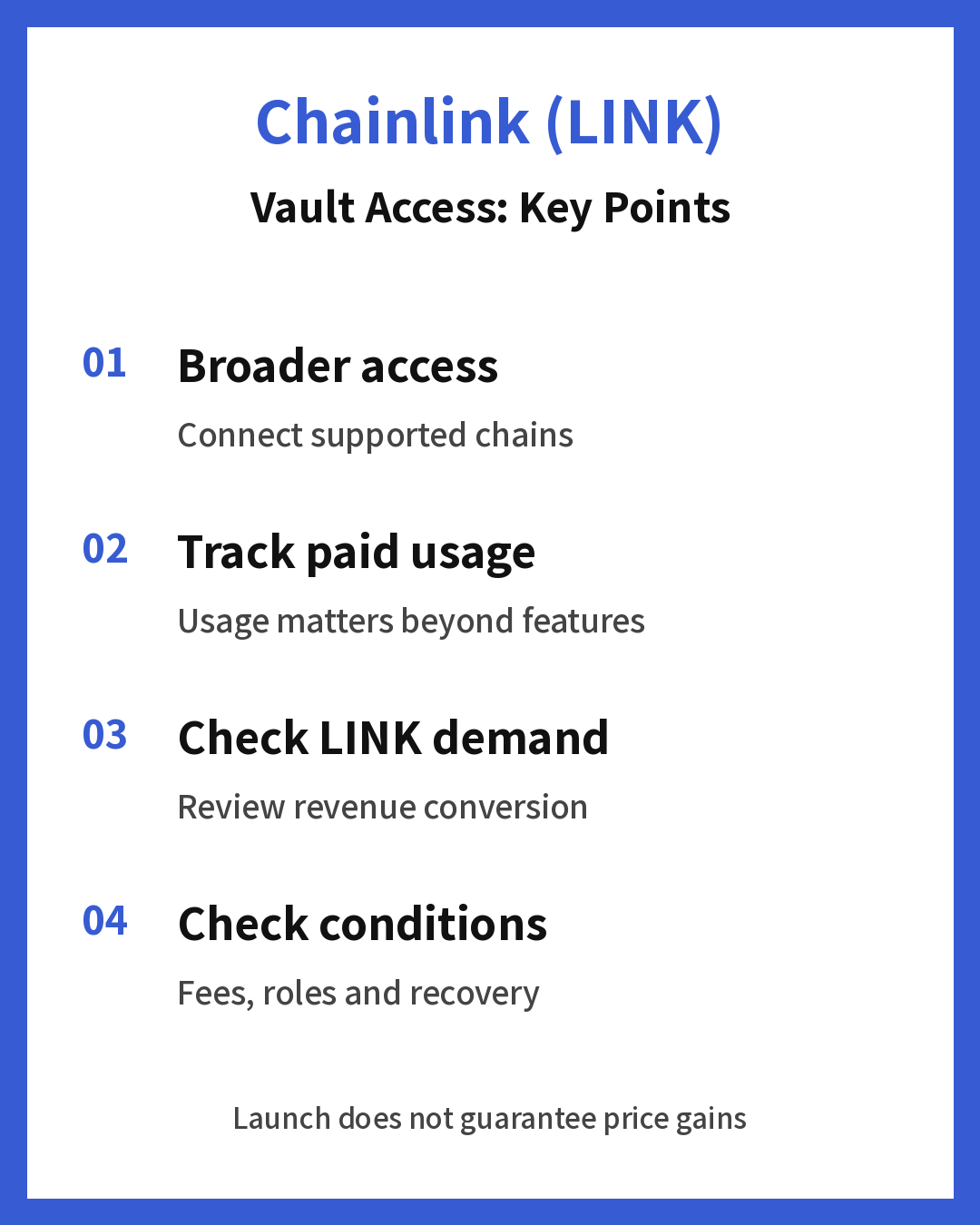
The development broadens access to a vault rather than requiring copies on every chain. LINK holders can track usage, service revenue and execution of LINK conversion mechanisms. This is a product-development analysis, so we have omitted live charts and numerical price targets.
Official Sources
- Chainlink — CCIP Vault Adapters announcement, Oct 8, 2026
- Chainlink Docs — Cross-Chain Vault Adapter, accessed Oct 12, 2026
- Chainlink — Economics, accessed Oct 12, 2026
- Chainlink — CCIP, accessed Oct 12, 2026
This article is for informational purposes only and does not constitute investment advice.