Pi Network Update: Where OUSD, PiVerify, SoloHost and DEX Stand Today

As of October 8, 2026 | Official announcements and conditional analysis
Quick Overview
Pi Network is extending its reach into financial partnerships, identity services, computing and blockchain trading features. These initiatives are at different stages: a partnership, a product release, an early beta and a Testnet experiment are different kinds of progress. This article examines what each development establishes and what evidence would demonstrate sustained adoption.
1. The broader direction
Understanding Pi requires looking at both PI as a transferable token and Pi technology as a platform for services. Businesses paying for verification, developers maintaining useful apps and users making recurring payments would provide evidence of practical adoption.
The recent developments span four areas: financial connectivity, digital identity, local computing and AI, and token exchange infrastructure. The presence of all four does not imply that they have reached the same level of commercial maturity.
2. Open Standard and OUSD: what is established?
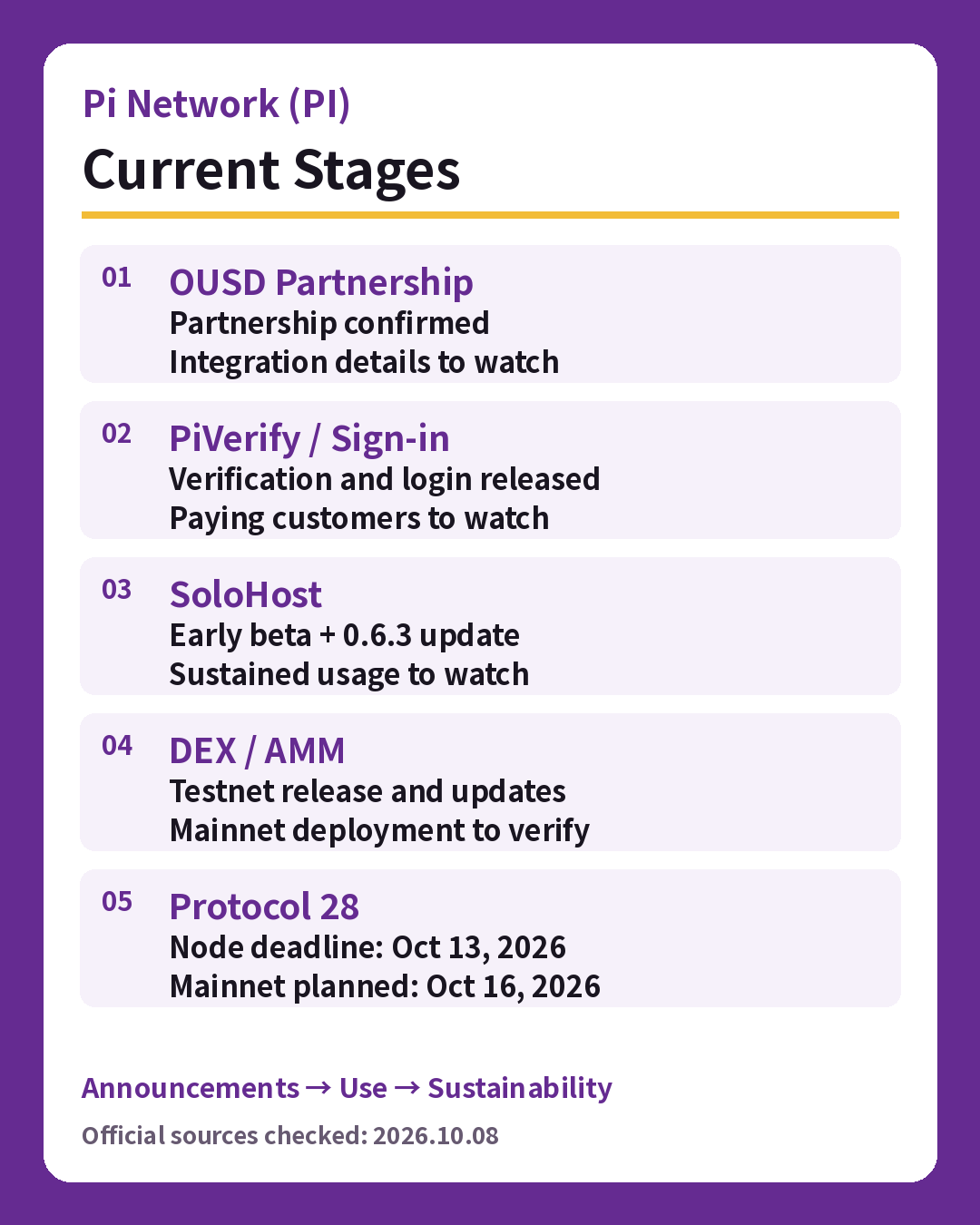
Pi's official announcement describes a partnership with Open Standard and plans to explore Pioneer reward programs and ecosystem utility. Pi Network also appears on Open Standard's partner list, updated September 30, 2026. [1][2]
Open Standard operates Open USD, or OUSD, a dollar-linked stablecoin. A stablecoin is a digital asset designed to track a reference asset's value.
Stripe announced OUSD support across its products on September 30. Its announcement names Coinbase, Mastercard, Shopify, Stripe and Visa as Open Standard's founding companies and describes more than 200 network partners. That count belongs to the announcement date. [3]
The established relationship is between Pi and Open Standard. It does not establish a separate direct investment or agreement between Pi and Visa or Mastercard. Stripe's OUSD support also does not establish support for PI payments.
The materials reviewed for this article do not establish that OUSD has already been issued on Pi Mainnet or fully integrated into Pi Wallet. Reward eligibility, terms, geographic availability and technical implementation require further details.
Analysis: This creates a business relationship that could support new payment or reward options. Assessing its impact requires an implemented service and evidence of use, rather than the partnership announcement alone.
3. The 12 KYB businesses
KYB, or Know Your Business, checks a business's identity and related information. KYC, or Know Your Customer, performs identity checks for individuals.
The official Pi KYB list reviewed on October 8 contains these 12 businesses. The grouping below is an editorial aid, not a classification of each company's entire business. [4]
| Area | Businesses on the official list |
|---|---|
| Exchanges and trading platforms | Kraken, OKX, Bitget, Gate, Pionex, LBank, MEXC |
| Purchase, payment and on-ramp services | Onramp.money, Onramper, Zypto, TransFi, Banxa |
An on-ramp lets people purchase cryptocurrency with conventional money. An off-ramp provides the reverse route.
The list is a reference for checking businesses claiming a Pi integration. KYB verification does not guarantee investment safety or the availability of every service. Supported countries, functions and deposit or withdrawal conditions still need to be checked with each provider.
Analysis: The useful measure is the range of services people can actually use. Business verification, implementation and transaction activity should be tracked separately.
4. PiVerify and Pi Sign-in
The June 28, 2026 Pi2Day announcement introduced PiVerify's release and the initial Pi Sign-in version. The direction of offering identity services externally had been outlined at the Open Network anniversary earlier in the year. June 28 should therefore be described as the release announcement, rather than the first mention. [5][6]
PiVerify offers KYC and real-human verification to external services. Pi's description says clients pay in PI. Pi Sign-in allows supported third-party websites and apps to use Pi accounts for login. [5]
These functions serve different purposes. Offering a Pi login does not by itself establish that every user has completed a separate identity-verification process for that third-party service.
Analysis: Recurring paid verification by external businesses could increase PI's use for service payments. The reviewed materials do not quantify external paying customers or revenue. Those figures, repeat usage and actual PI payment amounts would help assess commercial adoption.
5. SoloHost: running apps on your own computer
SoloHost is a framework in Pi Desktop for installing and running apps on personal computers. Pi's June 28 announcement described it as an early beta. A beta is an early operating stage in which usage and feedback help improve the product. [5]
The September 9, 2026 Pi Desktop 0.6.3 update improved discovery, management, reliability and developer troubleshooting. It included app rankings based on current running counts, a publisher management area and readiness checks for app responses. [7]
Local execution processes work on your own computer. Distributed computing divides work among multiple computers. These approaches can complement each other, but they are different concepts.
Analysis: Easier local execution provides a starting point for utility. A sustained computing service for outside customers also needs demand, performance, predictable costs, reliability and a workable compensation model. A beta release or interface improvement does not establish large-scale commercialization.
6. DEX and AMM: evidence from Testnet
Pi released DEX, AMM and token-creation features on Testnet on September 30, 2025. A DEX, or Decentralized Exchange, supports blockchain-based asset exchange. An AMM, or Automated Market Maker, processes swaps using assets in liquidity pools. [8]
A liquidity pool is a shared reserve of assets available for exchange. The December 18, 2025 update improved the interface, Pi-denominated trading pairs, liquidity organization and indicators for assessing tokens. [9]
Testnet uses test assets to evaluate functionality. It must be distinguished from Mainnet activity involving assets with real economic value. The DEX and AMM materials reviewed here describe Testnet features and updates; they do not establish a fully operating Mainnet financial market.
Analysis: Mainnet deployment needs its own official confirmation and operating evidence. Liquidity, security validation, token rules and sustained activity matter alongside technical availability.
7. Protocol 28: scheduled versus completed
Pi's official notice describes completion of the Protocol 27 Mainnet upgrade and the Protocol 28 Testnet upgrade. The Node upgrade deadline is October 13, 2026, ahead of the planned October 16 Mainnet network upgrade. Both dates are still in the future as of October 8. [1]
A node is a computer participating in network operations. A protocol defines the rules for processing data and executing network functions.
The notice describes improvements to delayed transaction data handling, group upgrades for smart contracts and safer changes to stored application data. A smart contract is a blockchain program that runs according to specified conditions.
Analysis: The upgrade can be assessed as an improvement to the development foundation. A scheduled date is not proof of completion; the completion announcement and subsequent operating conditions must be checked separately.
8. A simple analogy: a new shopping center
Imagine a new shopping center. A partnership resembles an agreement to bring in a tenant; a service release resembles opening a shop; beta and Testnet work resemble trial operations. Sustained progress requires customers who return and purchase services.
More signs above storefronts do not establish recurring sales. The analogy does not reproduce the technical architecture, but it helps distinguish announcements from adoption.
9. Conditional outlook and useful indicators
These scenarios are analytical possibilities, not official targets or probability forecasts.
| Scenario | Required conditions | What to observe |
|---|---|---|
| Service expansion | Implemented integrations, outside paying customers and repeat use | Broader payment, identity and computing activity |
| Gradual development | Continued improvements while customer acquisition takes time | Usage grows slowly after releases |
| Commercial delays | Unresolved demand, cost, regulatory or reliability issues | Available features see limited sustained use |
The current materials do not establish which path will occur. Track the following with dates and sources:
- Are OUSD integrations and reward programs actually available?
- Does PiVerify attract external paying customers and recurring payments?
- Does SoloHost show sustained app use and paid computing demand?
- Are Mainnet DEX and AMM availability and activity officially established?
- Do service revenue, operating costs and usage indicate sustainability?
Investors should consider these distinctions too. Development and partnerships alone cannot quantify a token's economic outcomes. PI required for services, circulating supply and actual transaction conditions should be assessed together. Cumulative KYC verification figures should not be treated as active-user counts.
Key Takeaway
Pi's announcements show expansion into financial connectivity, identity, computing and blockchain trading infrastructure. Each area is at a different stage, so partnerships, releases, betas and Testnet experiments should be evaluated separately. Outside customers, repeat use, actual service payments and stable operations are the evidence to watch next.
Official Sources
- Pi Network announcements: Open Standard and Protocol 28 — posts 351 and 350; checked October 8, 2026
- Open Standard partner list — updated September 30, 2026; checked October 8
- Stripe: OUSD is now the default stablecoin on Stripe — September 30, 2026
- Pi Network KYB list — checked October 8, 2026
- Pi2Day 2026: Compute, AI, and Identity — June 28, 2026
- Open Network Anniversary Video — first published February 20, 2026; the page also displays a June 28 update
- SoloHost updates in Pi Desktop 0.6.3 — September 9, 2026
- Pi DEX, AMM and token creation on Testnet — September 30, 2025
- Pi DEX and AMM update — December 18, 2025
This article is for informational purposes only and does not constitute investment advice.