🌐 한국어로 읽기: Korean Version — link will be added after publication.
Quick Overview
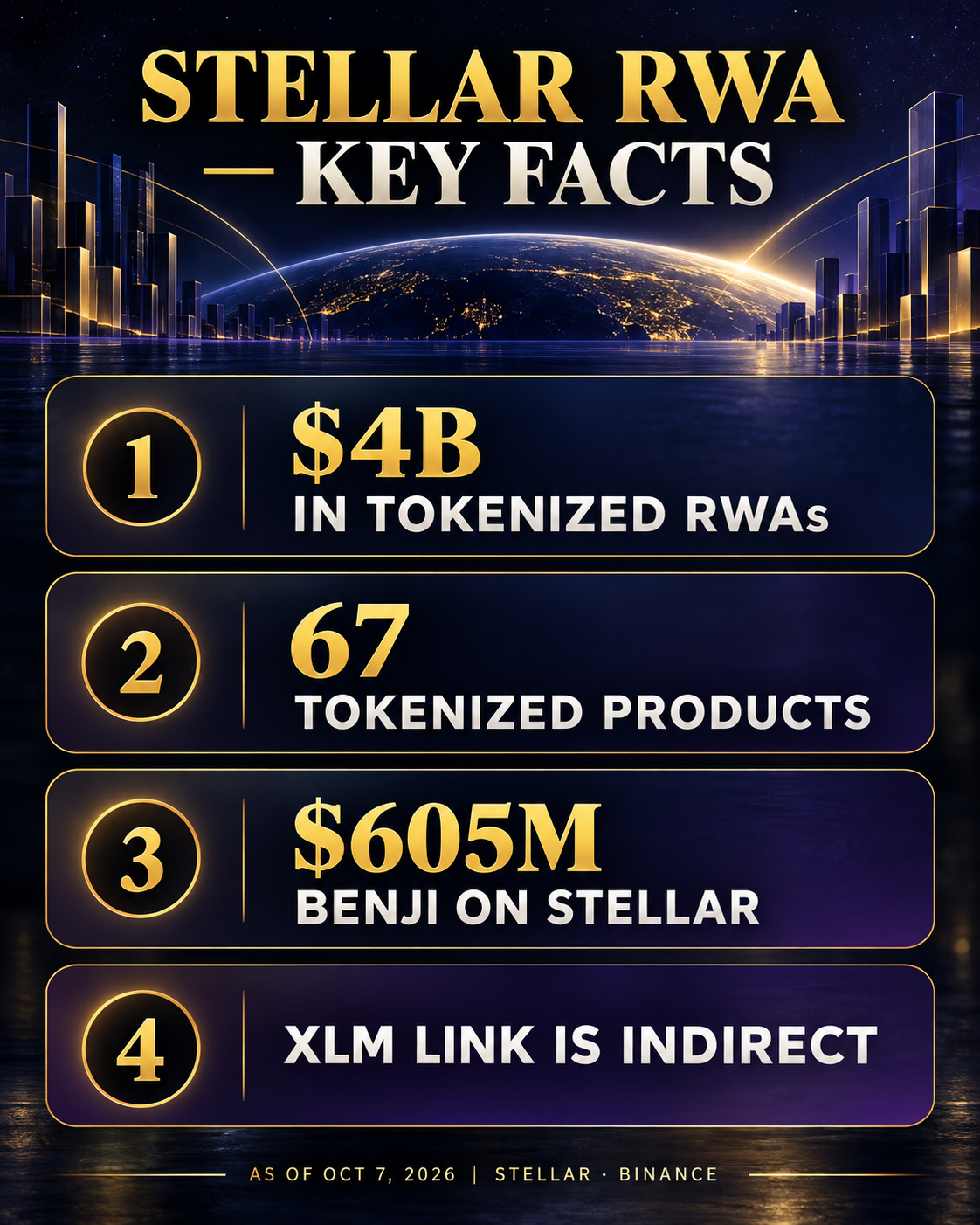
Stellar’s official RWA page reports $4 billion in tokenized real-world assets as of September 1, 2026, spanning 67 tokenized products from 10 regulated issuers. Franklin Templeton’s BENJI accounted for $605 million on Stellar as of October 6. This is meaningful institutional adoption, but it does not automatically translate into the same amount of demand for XLM.
The Key Development
Stellar’s RWA activity has moved beyond isolated pilots. Franklin Templeton has used the network since 2021 to maintain the official ownership record for its U.S.-registered Franklin OnChain U.S. Government Money Fund, whose shares are represented by BENJI. Stellar reports $605 million of BENJI on the network as of October 6, 2026.
The network also highlights 13 WisdomTree digital funds, Spiko money-market funds managed by Amundi, and Ondo’s Treasury-backed USDY. Taken together, the $4 billion figure reflects assets in production across multiple issuers and product types.
We classify the development as a B-grade positive catalyst: institutional deployment and live products are verified, while a direct link to incremental XLM demand remains unproven.
Why It Matters to Holders
More issued and transferred assets could strengthen Stellar’s position as financial infrastructure for regulated funds, settlement and payments. The network supports issuer controls such as authorization, freezing and clawback—features that regulated products may require.
Think of tokenization as giving a bond or fund share a digital warehouse receipt. The receipt records ownership and moves with an updated ledger. Stellar provides the ledger and transfer rail, although the analogy is not identical to the legal structure of every product.
Potential Impact on Token Demand and Price
XLM pays network fees, supports minimum account balances and can serve as a bridge asset in path payments. If more RWA issuance produces more transactions, accounts and liquidity routes that use XLM, network demand could benefit over time.
The link is indirect. Four billion dollars of assets on Stellar does not require four billion dollars of XLM purchases. Issuers can settle in their own tokens or stablecoins, and Stellar’s base fees are deliberately very low. Holders should watch active accounts, transfer activity, DEX liquidity, stablecoin payment volume and XLM’s share of routing—not just headline asset value.
Market & Chart Context — October 7, 2026
On Binance’s XLM/USDT spot market, the October 7 UTC daily candle opened at $0.2121, reached $0.2126, fell to $0.1984 and closed at $0.2005. Volume was about 91.13 million XLM, or $18.56 million in quote volume. Official market pages also confirmed XLM availability on Binance, Kraken and Coinbase.
The close was below the 20-day simple moving average of $0.2137 but above the 60-day average of $0.1895. Fourteen-day RSI was approximately 49.2, a neutral reading. Daily volume was below the 20-day average of roughly 130.22 million XLM.
The weekly candle was still incomplete, so it should not be treated as a confirmed weekly close. From October 5 through October 7, the partial week opened at $0.2241, traded as high as $0.2271 and as low as $0.1984, then ended October 7 at $0.2005.
Near-term support sits around $0.198–$0.200. A broader support zone appears near $0.182–$0.190, where the 60-day average and recent 20-day low converge. Resistance is around the 20-day average at $0.214, followed by $0.224–$0.227 and the recent 20-day high near $0.237. These are observation zones, not price targets.
- Bullish condition: reclaiming $0.214 with stronger volume, followed by acceptance above $0.227.
- Neutral condition: range trading between $0.198 and $0.214 on lighter volume.
- Bearish condition: losing $0.198 and then the 60-day average near $0.189, which would expose the $0.182 area.
What to Watch Next
First, check whether the $4 billion is moving through transfers and settlement rather than simply remaining issued. Second, look for growth across BENJI, Spiko, WisdomTree and USDY instead of concentration in one product. Third, verify whether increased activity creates measurable demand for XLM fees, reserves or bridge liquidity.
Stellar’s RWA growth is a real business and adoption milestone. For XLM investors, however, network growth and token value capture must be evaluated separately. The next useful signals are actual asset usage and the market’s response around the $0.198–$0.214 range.
Official Sources
- Stellar, Real-world asset tokenization — figures dated Sep. 1 and Oct. 6, 2026
- Stellar, Franklin Templeton case study — checked Oct. 6, 2026
- Stellar, Q2 2026 review
- Binance XLM/USDT — Oct. 7, 2026 UTC candle
- Kraken Stellar market page
- Coinbase Stellar market page
This article is for informational purposes only and does not constitute investment advice.
'English RWA > Other RWA Projects' 카테고리의 다른 글
| Stellar USDT0: Transfers and Risks (0) | 2026.10.07 |
|---|