
Quick Overview
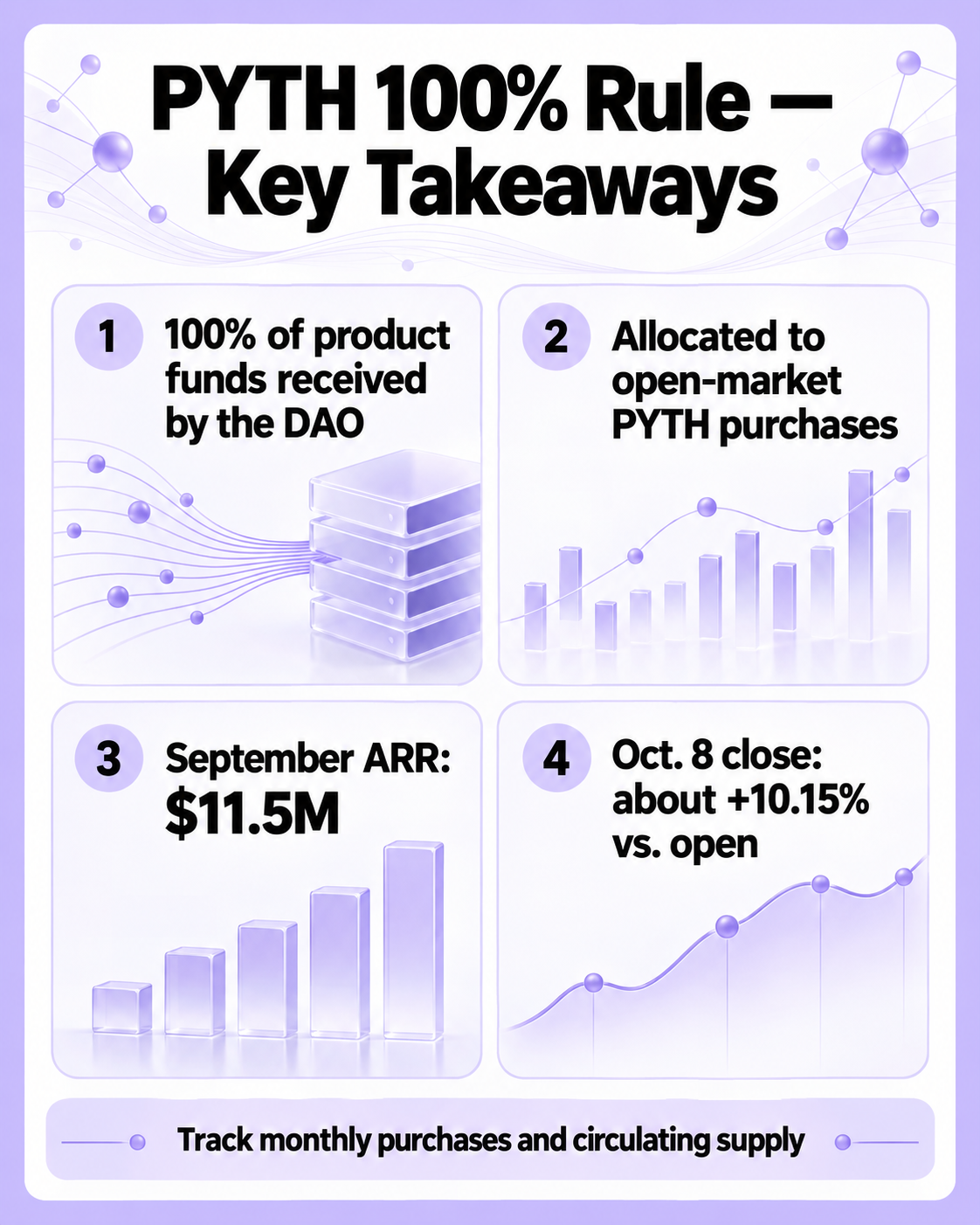
On October 8, 2026, Pyth Network announced the “100% Rule”: 100% of the product revenue funds actually received by the Pyth DAO will be allocated to open-market PYTH purchases. September overall annual recurring revenue (ARR) reached $11.5 million, while PYTH price and volume jumped around the announcement. This creates a clearer link between product adoption and token accumulation, but it does not guarantee a lasting price increase.
The Key Development
Passed proposal OP-PIP-136 replaced the prior reserve process. Previously, one third of the DAO’s non-PYTH balance was transferred each month and required a separate vote. The new standing authorization covers 100% of funds the DAO receives from Pyth Pro subscriptions, Listing as a Service, the Data Marketplace, Pyth Indices, and eligible non-PYTH assets already held by the DAO.
The precise wording matters: this is not 100% of all gross product revenue. Pyth’s announcement says the DAO receives a 60% share from DAO-owned products; the new rule governs 100% of what reaches the DAO. OP-PIP-136 does not change existing revenue-sharing percentages or payment terms.
The first acquisitions under the new authorization were executed on September 30 and are intended to remain visible through onchain transactions and monthly reporting. The official article uses both 41 million and 42 million PYTH for the reserve total, so this article does not treat either figure as a settled point-in-time balance.
What the $11.5M ARR Means
Pyth’s September 2026 report says overall ARR reached $11.5 million, up 10.6% month over month. Its Q3 recap gives a more precise $11.49 million in active ARR, up 86.5% quarter over quarter, including $9.68 million from Pyth Pro and $1.81 million from Pyth Indices.
ARR is like a speedometer that annualizes the current pace of recurring subscriptions. It is not the same as $11.5 million of cash already collected, and it is not the amount immediately available to the DAO. It is still useful evidence that Pyth’s paid data products are developing a repeatable commercial base.
Why It Matters to Holders
The policy makes the path from product adoption to token purchases easier to follow. Think of a business rule that automatically directs incoming product proceeds into inventory: if the DAO receives more product revenue, the funding available for PYTH accumulation can grow.
The link remains conditional. ARR and cash receipts occur on different schedules, purchases may be small relative to market liquidity or token unlocks, and reserve holdings do not automatically remove supply forever. Holders should track actual DAO receipts, monthly purchase amounts, execution prices, and reserve policy.
I classify the development as a B-level positive catalyst: formal approval and an initial execution are verified, but durable token demand and price effects still require monthly evidence.
Market & Chart Context: October 8–9
Using the Binance PYTH/USDT daily candles aggregated by MarketCapitalize in UTC, October 8 opened at $0.0738, reached $0.0860, fell as low as $0.0718, and closed at $0.0813. Volume was 183.41 million PYTH, and the close was about 10.15% above the open.
On October 9, PYTH opened at $0.0813, traded between $0.0788 and $0.0866, and closed at $0.0845 on 58.29 million PYTH of volume. The close gained roughly 3.97% from the open, while volume fell about 68% from the previous day. Price follow-through remained positive, but participation cooled after the initial reaction.
CoinGecko’s broader market aggregation also shows an October 8 close of $0.081204 and $35.29 million in volume, followed by $101.27 million in volume on October 9. Exchange-pair token volume and global dollar volume cover different markets and units, so they should not be compared directly.
Two days are not enough to confirm a long-term trend or price target. A constructive scenario would require a break above the roughly $0.086 area with renewed volume. A neutral scenario is consolidation between about $0.079 and $0.086. A weaker scenario would involve a move below $0.079 accompanied by expanding volume. These are monitoring conditions, not predictions.
How It Works — In Simple Terms
Pyth is an oracle network: a “translator” that delivers real-world market prices to blockchains and financial applications. Institutions and trading venues pay for data products. When the DAO’s contractual share arrives, the authorized operator can purchase PYTH in the open market under existing guardrails and add it to the reserve.
The benefit is a rules-based connection between product demand and token accumulation. The limitation is that ARR, cash received, dollars deployed, average purchase price, and reserve balance are separate numbers. “Revenue equals buybacks equals a higher token price” is too simplistic.
What to Watch Next
First, compare monthly DAO receipts with reported purchases and onchain transactions. Second, monitor whether the $11.5 million ARR level is maintained or expanded. Third, watch whether volume returns if PYTH tests the $0.086 area and whether roughly $0.079 acts as support. Finally, track token unlocks and reserve governance because new supply or future reserve use can offset purchase pressure.
Key Takeaway
The 100% Rule creates a clearer and stronger path from Pyth’s data business to PYTH accumulation. The initial market reaction was visible, but the durable investment case depends on actual DAO receipts, recurring monthly execution, market liquidity, and circulating supply—not the announcement headline alone.
Official Sources and Market Data
- Pyth Network, “The 100% Rule” — Oct. 8, 2026
- Pyth DAO, Passed OP-PIP-136 — Sept. 24, 2026
- Pyth September 2026 Report — Oct. 5, 2026
- The Market Data Layer for New Financial Markets — Oct. 8, 2026
- MarketCapitalize, Binance PYTH/USDT daily aggregation — accessed Oct. 10, 2026
- CoinGecko, Pyth Network Historical Data — accessed Oct. 10, 2026
This article is for informational purposes only and does not constitute investment advice.
'English RWA > Other RWA Projects' 카테고리의 다른 글
| Stellar’s $4B RWA Footprint: What It Actually Means for XLM Holders (0) | 2026.10.08 |
|---|---|
| Stellar USDT0: Transfers and Risks (0) | 2026.10.07 |